
Betting Explained
 Available in US
If you’ve bet on basketball or football, you understand spreads. The favorite gives points, the underdog gets points, and the final margin determines who covers. Hockey has its own version of this concept, and it goes by a name that sounds like it belongs at a Canadian diner: the puck line.
The puck line confuses newcomers because hockey doesn’t produce enough goals for traditional spread betting to make sense. You can’t give a team -7.5 goals when most games finish 4-2 or 3-1. So the puck line uses a fixed spread — almost always 1.5 goals — and adjusts the odds instead of the number. This creates a betting market with different risk-reward dynamics than the moneyline, and understanding when to use it separates casual bettors from those who consistently find value.
This guide breaks down everything about puck line betting: how it works, when it makes sense, the strategies that exploit it, and the mistakes that cost bettors money. By the end, you’ll know exactly when the puck line offers better value than a straight moneyline bet and when it’s a trap waiting to snap shut.
See also the puck line betting guide.
What is a Puck Line?

The puck line is hockey’s point spread, set at 1.5 goals in virtually every game. The favorite is listed at -1.5, meaning they must win by two or more goals for the bet to cash. The underdog sits at +1.5, meaning they can lose by a single goal and still cover. This fixed spread creates a standardized betting market where the odds, rather than the spread itself, reflect each team’s perceived edge.
In a typical matchup between evenly matched teams, you might see the puck line priced at -1.5 (+150) for the favorite and +1.5 (-170) for the underdog. The plus odds on the favorite indicate that winning by two goals is harder than simply winning. The minus odds on the underdog reflect that losing by just one (or winning outright) is easier than winning outright.
Compare this to football, where the spread moves based on the perceived talent gap. A dominant NFL team might be -14.5 against a weak opponent, while a close matchup sits at -2.5 or -3. In hockey, the spread stays fixed at 1.5 because the scoring variance doesn’t support larger numbers. Instead, a heavy favorite might be -1.5 (-200) while a slight favorite is -1.5 (+180). The spread doesn’t change; the price does.
This structure creates interesting betting opportunities. When you think the favorite will dominate, the puck line offers bigger payouts than the moneyline. When you think the underdog will keep it close, taking +1.5 provides a cushion that can turn a loss into a win. The math works differently than moneyline betting, and that difference is exactly where value hides.
Puck Line vs. Moneyline

Choosing between the puck line and moneyline isn’t just about preference. It’s a mathematical decision that depends on the specific game, the odds available, and your read on how the match will unfold. Each market has its place, and using the wrong one in the wrong spot costs money over time.
When the Moneyline Makes Sense
The moneyline is straightforward: pick the winner. If you take a -180 favorite, they need to win by any margin. That includes overtime victories, shootout wins, and games decided by a single goal with three seconds left. The moneyline doesn’t care about margin; it only asks who wins.
This simplicity makes the moneyline ideal for games you expect to be close. If two evenly matched teams are battling and you like the slight favorite at -140, the moneyline lets you profit from any victory. Taking the same team at -1.5 (+160) means a 2-1 or 3-2 win becomes a loss. In tight games, that extra cushion the puck line requires often doesn’t materialize.
The moneyline also works better when you have strong conviction but uncertain margin expectations. Maybe you know Team A is better than Team B, but the stylistic matchup suggests a grinding, low-scoring affair. The moneyline captures your conviction without demanding a specific type of victory.
When the Puck Line Offers Value
The puck line shines when you expect a blowout. Suppose you love a heavy favorite, but the moneyline sits at -280. You’d need to risk $280 to win $100 — a steep price for a single hockey game where upsets happen regularly. The same team at -1.5 (-120) offers a much better return, and if you genuinely expect them to dominate, the two-goal margin shouldn’t scare you.
Here’s the core concept: the puck line converts conviction about margin into better odds. If you believe the favorite will cruise, you’re essentially selling your confidence in a close game to buy a cheaper price. This trade-off is profitable when your margin predictions are accurate and costly when they’re not.
Puck line underdogs work in reverse. Taking +1.5 goals means you can lose the game and still cash the bet, as long as the loss is by a single goal. This is enormous in hockey, where nearly half of games are decided by exactly one goal. If you like an underdog but don’t trust them to win outright, the +1.5 provides a valuable safety net.
Risk and Reward Dynamics
The risk profiles of these markets differ substantially. Moneyline favorites carry heavy juice but require only a win. Puck line favorites offer better odds but demand a margin. Moneyline underdogs pay well if they pull the upset but offer no consolation for close losses. Puck line underdogs pay less but cash far more often.
Consider a practical example. You’re evaluating a matchup where the favorite is -200 on the moneyline and -1.5 (+135) on the puck line. If you bet $100 on the moneyline and they win, you profit $50. If you bet $100 on the puck line and they win by two or more, you profit $135. The puck line pays 2.7 times as much, but it requires that extra goal margin.
Historical NHL data shows that favorites win roughly 60% of games but cover -1.5 only about 40% of the time. Those numbers shift based on the specific matchup, but the gap is always significant. The puck line isn’t a free upgrade to better odds; it’s a fundamentally different bet with different probabilities.
How Puck Line Odds Work
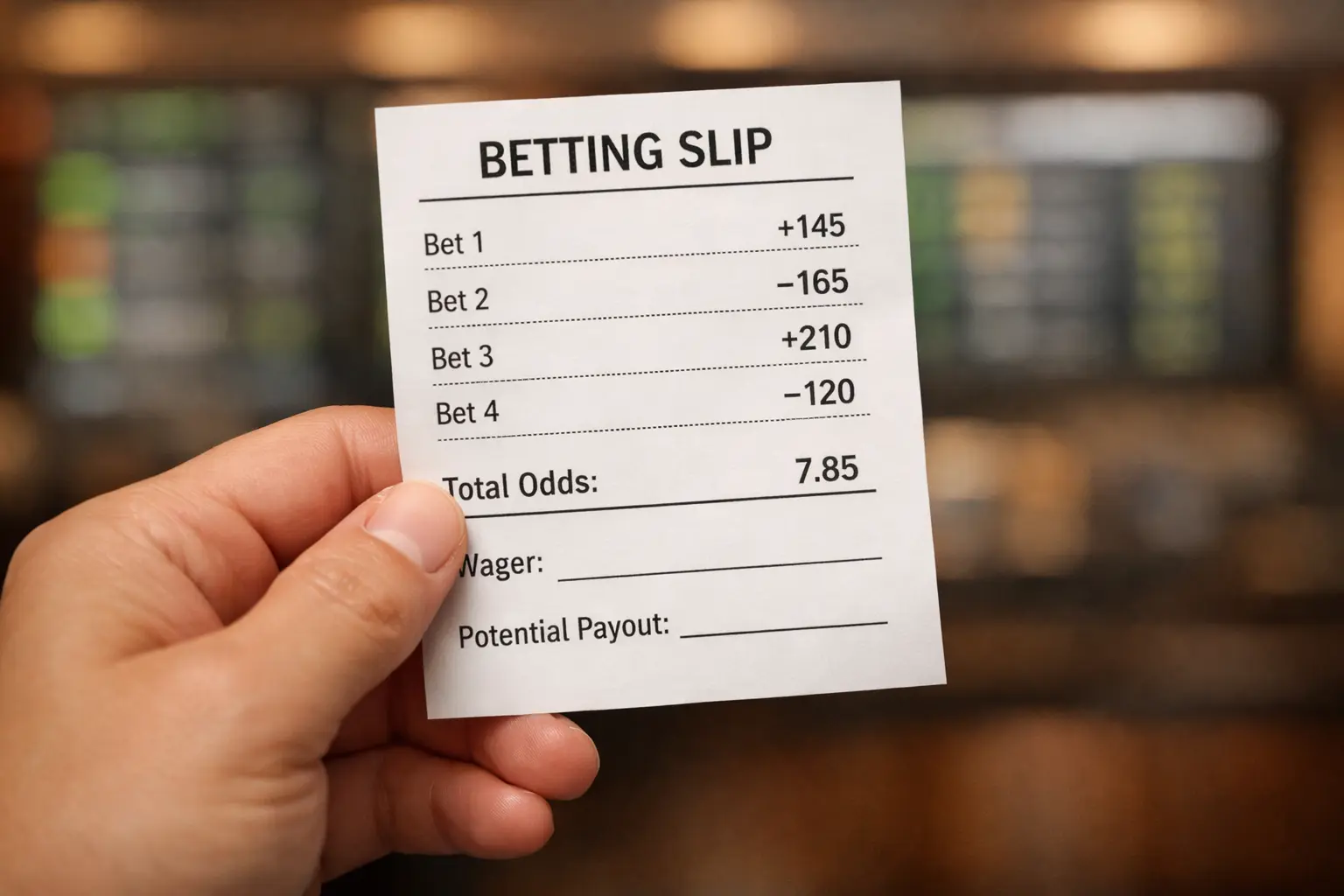
Puck line odds follow the same American format as other sports bets. Positive odds indicate what you profit on a $100 bet; negative odds indicate what you must risk to profit $100. The spreads stay constant, so all the information about the expected margin lives in the pricing.
Reading the Numbers
When you see a puck line listed as -1.5 (+145), the favorite must win by two or more goals for your bet to cash. The +145 means a $100 wager returns $145 profit (plus your stake back) if successful. This positive number reflects that covering -1.5 is difficult — you’re being compensated for taking on that risk.
The underdog at +1.5 (-165) wins if they either win outright or lose by exactly one goal. The -165 means you must risk $165 to profit $100. This negative number indicates a higher probability of success, since losing by one goal is a much easier condition to meet than winning outright.
The relationship between favorite and underdog puck line prices is essentially inverse. When the favorite’s -1.5 price is highly positive (say, +180), the underdog’s +1.5 will be correspondingly negative (-210 or so). When the favorite is heavily juiced on the moneyline, their puck line price drops closer to even money or slightly negative, while the underdog’s +1.5 becomes a smaller negative or even positive.
Calculating Payouts
For positive odds, the formula is simple: (Odds / 100) x Stake = Profit. A $50 bet at +145 yields (145/100) x 50 = $72.50 profit.
For negative odds, flip the equation: (100 / Odds) x Stake = Profit. A $50 bet at -165 yields (100/165) x 50 = $30.30 profit.
Understanding these calculations lets you compare value across different markets. Sometimes the puck line offers mathematically better expected value than the moneyline; sometimes it’s worse. You can’t know which is true without running the numbers.
Implied Probabilities
Odds translate to implied probabilities. A +145 puck line implies roughly 40.8% probability (100/245). A -165 puck line implies roughly 62.3% probability (165/265). These implied probabilities don’t add to 100% because of the sportsbook’s vig — the house edge built into every line.
Compare implied probabilities to your own assessments to find value. If you believe a favorite has a 48% chance of winning by two or more goals, but the puck line prices that outcome at 40%, you’ve found an edge. The gap between your estimated probability and the market’s implied probability is where profit lives.
Alternate Puck Lines
Standard puck lines use 1.5 goals, but most sportsbooks offer alternate lines that expand or shrink the spread. These alternates create additional betting options with different risk-reward tradeoffs.
Wider Spreads: -2.5 and Beyond
Taking a favorite at -2.5 means they must win by three or more goals. This is a blowout scenario, and the odds reflect it. A team that’s -1.5 (+145) might be -2.5 (+280) or even higher. You’re getting excellent odds, but you need a dominant victory.
These wide spreads work for specific situations: games where a powerhouse faces a genuinely outmatched opponent, especially if the weaker team is playing a backup goalie or missing key players. They’re also useful for playoff series when one team has clearly established dominance. However, the frequency of three-goal NHL victories is low enough that -2.5 bets are inherently high-variance.
On the underdog side, +2.5 means they can lose by two goals and still cash. This is a very comfortable cushion in hockey, where most losses are by one or two goals. The odds will be heavily juiced (think -300 or worse), but the bet cashes frequently. Some bettors use +2.5 underdogs as foundations for parlays, adding legs to build up the return on a likely outcome.
Tighter Spreads: The -0.5 Concept
Some sportsbooks offer a -0.5 puck line, which is functionally identical to the moneyline for favorites (they must win by at least one goal, so any win covers). This might seem pointless, but it exists primarily for parlay construction and to provide identical formatting across sports.
More interesting is the +0.5 underdog, which essentially turns the moneyline into a bet that includes ties at the end of regulation. Wait, hockey doesn’t have ties? Correct — but games do go to overtime and shootouts, where either team can win. A +0.5 underdog wins if they either win outright or force overtime (since they’ll have “not lost in regulation”). This market is sometimes called the “60-minute line” or “regulation tie no bet” in various formats.
When to Use Alternate Lines
Alternate puck lines should reflect strong opinions about game script. If you believe a game will be a blowout, consider -2.5 on the favorite for plus-money odds. If you believe a heavy underdog will keep things respectable without necessarily winning, +2.5 offers frequent cashes despite the juice.
The key is avoiding alternates as a compromise when you’re unsure about the standard line. Widening the spread to chase better odds only works if you genuinely expect the outcome that spread requires. Spreading to +2.5 because you can’t decide between the underdog’s moneyline and +1.5 isn’t strategy — it’s indecision wearing a costume.
Puck Line Betting Strategies
Successfully betting puck lines requires understanding which situations favor each side of the spread. The following strategies identify spots where historical data and game theory suggest the puck line offers value.
Targeting Heavy Favorites
When a favorite is -250 or steeper on the moneyline, the puck line becomes increasingly attractive. The moneyline requires risking massive amounts to win modest returns, while the puck line at -1.5 often sits around -110 to +130. You’re still betting on the better team, but the odds improve dramatically.
Heavy favorites exist for reasons: they’re better teams facing weaker opponents. These mismatches produce multi-goal victories more often than close matchups. The same factors that create -300 moneylines — elite goaltending, dominant offense, struggling opponents — also create conditions for puck line covers.
Track the performance of heavy favorites against the puck line across different moneyline thresholds. Historically, favorites above -200 cover -1.5 at elevated rates compared to slight favorites, though the prices adjust somewhat. Finding the sweet spot where the odds haven’t fully caught up to the probability is the goal.
Backing Underdogs in Close Games
The +1.5 puck line transforms how you can approach underdog betting. Instead of needing an upset, you need a competitive game. Underdogs that keep games within a goal — whether they ultimately win, lose in overtime, or drop a one-goal decision — all cash the +1.5.
Look for underdogs with strong defensive structures but limited offensive firepower. These teams might not score enough to win, but they can prevent blowouts. A well-coached team with good goaltending can hang around against superior opponents even when they don’t have the skill to pull off the upset.
Home underdogs deserve particular attention for +1.5 bets. Home ice advantage in hockey is real but modest — roughly 4-5% win probability. However, home teams also tend to play more structured hockey in front of their own fans, which limits blowouts. A home underdog at +1.5 with a capable goalie is often a solid position.
Combining Puck Line with Totals Analysis
The relationship between puck lines and totals creates correlated betting opportunities. High totals suggest more goals, which means more margin for the favorite to win by. Low totals suggest grinding games where single-goal outcomes are common, favoring the underdog +1.5.
When you believe a game will be high-scoring and expect the favorite to drive that offense, the -1.5 puck line plus the over is a logical combination. If you believe the underdog will hang tough in a defensive struggle, +1.5 and the under often correlate positively.
This doesn’t mean you should always parlay these bets — correlation isn’t causation, and both legs can lose independently. But analyzing totals context helps you evaluate puck line value. A +1.5 underdog in a game with a 6.5 total faces tougher math than one in a 5.0 total game.
Empty Net Goals and Late-Game Scenarios
Empty net goals have an outsized impact on puck line betting. When a trailing team pulls their goalie in the final minutes, they’re essentially conceding a high percentage of goals scored against them. Games that were 2-1 or 3-2 often end 4-2 or 4-3 with an empty-netter sealing the margin.
For puck line favorites, this is a bonus. A one-goal lead with two minutes left becomes a two-goal victory roughly 30-40% of the time thanks to empty net situations. For underdogs, it’s a disaster. You might be covering +1.5 with a minute left, only to watch a desperation empty-net goal steal your bet.
Factor empty net probability into your puck line analysis. Favorites with strong defensive play and the ability to suppress shots will protect one-goal leads better than teams that give up chances. Underdogs with poor possession metrics are more likely to surrender empty-netters after pulling their goalie.
Puck Line in Live Betting
Live betting unlocks puck line opportunities that don’t exist pre-game. As games unfold, the spread and odds shift based on the current score, time remaining, and game flow. Understanding these dynamics lets you find value during the action.
How Spreads Shift During Games
When a favorite scores first, their puck line becomes harder to reach (they’ve already used one goal of margin, so they need another for -1.5 to cover while also maintaining the lead). The odds adjust accordingly, sometimes dramatically. A -1.5 (+140) pre-game might become -1.5 (+200) after the favorite goes up 1-0 because they now need to score again without allowing goals.
Conversely, when the underdog scores first, their +1.5 becomes nearly locked in — they can now lose by two goals and still cover what was a one-goal cushion. The +1.5 price will drop to heavily negative (think -350 or more), reflecting the near certainty of cashing.
These shifts create arbitrage-adjacent situations for alert bettors. If you took +1.5 pre-game and the underdog scores first, you might be able to hedge with a live -1.5 bet at plus odds, guaranteeing profit regardless of outcome.
Capitalizing on Momentum Swings
Hockey momentum is real but overstated in markets. When a favorite falls behind, live bettors often panic and the -1.5 price can balloon to +300 or higher. If the favorite is genuinely the better team and the deficit came from a fluky goal, this overreaction creates value.
The reverse applies too. An underdog who takes an early lead might see their +1.5 price drop unnecessarily. If you expect the favorite to mount a comeback, fading the live underdog — perhaps by taking the favorite’s live puck line at an inflated price — captures value from emotional overreaction.
Read the game state carefully before betting live puck lines. The score matters, but so does shot differential, time remaining, and special teams situations. A team down 2-1 with a power play coming and heavy shot dominance is in better position than one who’s been outplayed and got lucky on their only two shots.
Puck Line in Playoffs vs. Regular Season

Playoff hockey is structurally different from the regular season, and puck line betting requires adjustment. The games are tighter, the stakes are higher, and the patterns that work from October through April may not apply in May and June.
Tighter Games in Playoffs
Playoff games average fewer goals than regular season games. Teams play more carefully, checking intensifies, and goalies face more pressure situations. The reduced scoring creates more one-goal games, which directly impacts puck line math.
When one-goal games are more common, the favorite’s -1.5 covers less often. A team that covered -1.5 at a 42% clip during the regular season might drop to 35% in the playoffs. The odds adjust somewhat, but not always enough. Playoff puck lines on favorites are often traps unless you have specific reasons to expect a blowout.
Underdog +1.5 bets become correspondingly more valuable. The cushion of losing by exactly one goal, always useful, becomes even more likely to pay off in grinding playoff series. Even heavy underdogs tend to keep playoff games closer than their regular season matchups would suggest.
Adjusting Strategy for Postseason
Playoff series create additional context for puck line betting. Games after a blowout often produce tighter follow-ups, as the losing team adjusts and the winning team may experience a letdown. The “first to four wins” format means teams pace themselves differently than in standalone regular season games.
Series situations matter too. A team facing elimination plays with desperation that often translates to close games regardless of talent gap. Conversely, a team with a 3-0 series lead might coast somewhat, creating blowout potential in clinching games. Read the series dynamics, not just the game.
Avoid betting puck lines in playoff overtime the same way you would regulation. Once a game reaches overtime, the next goal wins and margins don’t exist. If you’re holding a puck line bet when a game goes to OT, you’re waiting to see if the original margin holds. Overtime goals don’t expand it.
Common Puck Line Mistakes

Even experienced bettors fall into predictable traps with puck line betting. Recognizing these mistakes helps you avoid costly errors.
Overvaluing Favorites
The biggest puck line mistake is assuming good teams will win by multiple goals. Favorites are favorites because they’re better, but “better” doesn’t mean “dominant.” The NHL has exceptional parity. The gap between the best team and a middling playoff team is far smaller than in the NFL or NBA.
Check historical margin data before betting favorites on the puck line. Many teams that look dominant post modest margins of victory. They win a lot of 3-2 and 4-3 games, which is enough for moneyline success but disastrous for -1.5 bets. Unless a team specifically produces blowouts, their -1.5 prices often overstate their probability of covering.
Ignoring Margin of Victory Trends
Not all favorites are equal on the puck line, even at similar moneyline prices. Some teams win big when they win; others grind out close victories consistently. The moneyline doesn’t distinguish between these patterns, but puck line betting demands that you do.
Research each team’s margin of victory distribution. A team that wins 60% of their games by two or more goals is a far better puck line bet than one who wins 60% of their games by exactly one goal. This information isn’t hidden — it’s in the basic game logs — but many bettors ignore it.
Situational factors affect margins too. Teams playing inferior opponents might run up the score. Teams in tight divisional battles might conserve energy once they have a lead. Look beyond overall statistics to understand how specific matchups might unfold.
Not Checking Goalie Matchups
Goaltending affects puck lines even more directly than moneylines. A backup goalie might let in an extra goal or two, which can be the difference between covering and not covering the spread. Yet bettors routinely bet puck lines before goalies are confirmed.
Always verify starting goalies before betting any puck line. If the favorite’s backup is starting, their -1.5 becomes much harder to cover — worse goaltending means more goals against, which shrinks the margin. If the underdog has their backup in, the favorite’s -1.5 actually improves because the opponent is weaker.
The timing of goalie confirmations creates betting opportunities. If you get confirmed goalie news before the line adjusts, you can capture value that disappears within minutes. Build this into your betting process as a standard check.
Chasing Plus Odds Without Context
Plus odds on puck line favorites look attractive compared to steep moneyline juice, but they’re only valuable if the probability of covering justifies the price. A -1.5 (+150) bet that covers 35% of the time is a losing proposition. The plus sign isn’t free money — it’s compensation for added difficulty.
Calculate the break-even percentage for any puck line bet. At +150, you need to win 40% of the time to break even. At +200, the threshold drops to 33%. Compare these break-even points to realistic cover rates based on the specific matchup. If the math doesn’t work, the attractive odds are actually a trap.
Putting It Together
Puck line betting isn’t better or worse than moneyline betting. It’s a different tool for different situations. The moneyline asks “who wins?” while the puck line asks “who wins and by how much?” Knowing which question matches your analysis for each game is the core skill.
Start by developing your own assessments of game margins. Don’t just pick winners; estimate how each game will unfold. Will it be a tight defensive battle or an open, high-scoring affair? Does one team have clear advantages that translate to margin, or are they just slightly better in ways that produce narrow victories?
Match those assessments to the available markets. If you expect a blowout, the puck line offers value over the moneyline. If you expect a close game, the moneyline (or +1.5 on the underdog) makes more sense. If you’re unsure about margin, the moneyline removes that variable from your bet.
Track your results separately for moneyline and puck line bets. You might discover that your moneyline instincts are sharp but your margin predictions are off, or vice versa. Use this information to refine where you focus your action. Not everyone needs to bet both markets — some bettors specialize in one and ignore the other entirely.
The puck line exists because different bettors want different risk profiles. Use it when it serves your purposes, ignore it when it doesn’t, and always understand the math behind the odds you’re taking. The spread doesn’t change, but your understanding of it can improve with every bet you track.
Puck line betting explained at ice hockey bets.
